Showing posts with label Egyptian. Show all posts

Friday, December 29, 2006

Egyptian Nobel Prize winners !


President, Mohamed Anwar El-Sadat, Nobel Prize for Peace, 1978

"For contribution to the two frame agreements on peace in the Middle East, and on peace between Egypt and Israel, which were signed at Camp David on September 17, 1978."


-------------------------------------------------------------


Naguib Mahfouz , Nobel Prize for Literature , 1988


"who, through works rich in nuance - now clear-sightedly realistic, now evocatively ambiguous - has formed an Arabian narrative art that applies to all mankind".

-------------------------------------------------------------


Ahmed Zewail , Nobel Prize for Chemistry , 1999

"for his studies of the transition states of chemical reactions using femtosecond spectroscopy"


-------------------------------------------------------


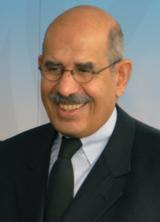
Mohamed ElBaradei,Nobel prize for Peace,2005


"for their efforts to prevent nuclear energy from being used for military purposes and to ensure that nuclear energy for peaceful purposes is used in the safest possible way"

Mohamed El-Baradei ..a pride for Egyptians

Mohamed El-Baradei (born June 17, 1942, Egypt) is the Director General of the International Atomic Energy Agency (IAEA), an inter-governmental organization under the auspices of the United Nations. El-Baradei and the IAEA were jointly awarded the Nobel Peace Prize in 2005.
El-Baradei earned a Bachelor degree in Law from the University of Cairo in 1962 and a Doctorate in International Law at the New York University School of Law in 1974. His diplomatic career began in 1964 in the Egyptian Ministry of Foreign affairs, where he served on two occasions in the Permanent Missions of Egypt to the United Nations in New York and Geneva. In 1980 he became a senior fellow in charge of the International Law Program at the United Nations Institute for Training and Research.
Since 1984, El-Baradei has been a senior member of the IAEA Secretariat, holding a number of high-level positions. Before his current position of Director General, he has been the agency's legal adviser (1984 to 1993) and Assistant Director General for External Relations (1993 to 1997).
El-Baradei is also a member of the International Law Association and the American Society of International Law. He is married to Aida El-Kachef, a kindergarten teacher at Vienna International School, and has two children, Laila and Mostafa.
El-Baradei has served as the Director General for the IAEA for two terms since December 1, 1997, and is now set for a third term after the current US administration reluctantly reversed its opposition to him in June 2005.
2005 Nobel Peace Prize: The International Atomic Energy Agency and its chief Mohamed El Baradei were awarded the Nobel Peace Prize for 2005. Mr. El Baradei and the agency will share the prize.
The chairman of the committee, Ole Danbold Mjos, announced the winner beneath crystal chandeliers in a small vaulted room on the third floor of the Norwegian Nobel Institute. The winner was chosen from nearly 200 nominees, a record for the prize, first awarded in 1901. Front-runners are believed to have included people as diverse as Finnish peace mediator Martti Ahtissari, anti-nuclear activist and Nagasaki survivor Senji Yamaguchi and Irish rock singer Bono. The prize is one of five Nobel Prizes endowed by the Swedish industrialist Alfred Nobel, who said in his will that the prize should be awarded "to the person who shall have done the most or the best work for fraternity between the nations, for the abolition or reduction of standing armies and for the holding and promotion of peace congresses."
At the time that Mr. Nobel stipulated the terms of the prizes, Norway and Sweden were politically united. The other prizes are awarded in Stockholm, Sweden.
President Hosni Mubarak hosted a ceremony on Tuesday February 7 in honor of Director General of the International Atomic Energy Agency Dr. Mohamed al-Baradei for being awarded the 2005 Nobel Peace Prize.
The President handed al-Baradei the Nile Collar, the highest ranking of all Egyptian decorations. It is known to be granted exclusively to kings, heads of state and those who render great services at the national and human levels in general.

Sir Magdi Yacoub


Professor Magdi Yacoub was born in a little village in Egypt. His father was a surgeon, constantly moving from one place to another depending on the need for surgeons around the country. This greatly affected his childhood as it meant moving every three or four years. This taught him two important things. Firstly, you have to be able to adapt, and, secondly, the enjoyment that comes with meeting and interacting with lots of different people. These lessons have served him well throughout his life.


Magdi Yacoubs work is all about helping people live longer and more fulfilling lives and describes "seeing people who are not well getting so much better" as the most satisfying part of his job. His strong sense of social responsibility led him to establish the Chain of Hope charity, which sends teams of medics to the developing world to treat children suffering from heart disease free of charge. With all the knowledge we have scientifically, we have a responsibility to help," he says. Magdi is personally involved in the charitys missions and had just returned from Mozambique.As well as treating children, the charity works to build up developing countries capacity to do operations and carry out research themselves. It helped to establish Maputo Heart Institute in Mozambique, which is training doctors and investigating how to treat EMS, a neglected heart disease. This disease affects up to 15% of children and young adults and leads to premature death. The charity also brings promising doctors from Mozambique to the UK for further training. Similarly 2 or 3 children from the developing world come to London for operations each month."The charity is called a Chain of Hope, because of the chain of people involved in the work we do - people donating money, people acting as host families for children and people donating their medical expertise," Magdi says.

Sunday, December 24, 2006

1,000+ Egyptian Military Officers Executed by Israeli Army in 1967

Washington Report readers know the story well. In 1967 on the fourth day of the Six Day War, the armed forces of Israel attacked the American intelligence ship USS Liberty for 90 minutes in international waters in broad daylight following several hours of close, low-level reconnaissance. Thirty-four men died, 171 were hurt, and the ship was so badly damaged that it had to be scrapped.
The government of Israel has lied about the circumstances ever since, telling a story markedly different from that told by American survivors. Congress has refused to question Israel's demonstrably false account, even though the State Department's own analysis finds the Israeli story to be untrue.
Yet the most pressing question remaining from that infamy is not whether the attack was deliberate. That was settled long ago for most reasonable people. The question is why Israel risked its cozy relationship with America by killing American seaman on the high seas.
Indeed, spokesmen for Israel use that question in Israel's defense. Why, they ask, would Israel risk alienating its American friends?
So why did Israel attack? Intelligence analysts and others have long supposed that Israel attacked to prevent the ship from reporting the impending invasion of the Golan Heights, then imminent despite cease fire pleas by the United States. Israel's defenders reject that explanation.
Recent reports in the Israeli and Egyptian press suggest another powerful possibility.
According to eyewitness accounts by Israeli officers and journalists, the Israeli Army - the army that claims to hold itself to a higher moral standard than other armies - executed as many as 1,000 Arab prisoners during the 1967 war.

Historian Gabby Bron wrote in the Yediot Ahronot in Israel that he witnessed Israeli troops executing Egyptian prisoners on the morning of June 8, 1967, in the Sinai town of El Arish.
Bron reported that he saw about 150 Egyptian POWs being held at the El Arish airport where they were sitting on the ground, densely crowded together with their hands held on the back of their necks. Every few minutes, Bron writes, Israeli soldiers would escort an Egyptian POW from the group to a hearing conducted by two men in Israeli army uniforms. Then the man would be taken away, given a spade, and forced to dig his own grave.
"I watched as (one) man dug a hole for about 15 minutes," Bron wrote. "Afterwards, the (Israeli military) policeman told him to throw the shovel away, and then one of them leveled an Uzi at him and shot two short bursts, each of three or four bullets."
Bron says he witnessed about ten such executions, until the grave was filled. Then an Israeli Colonel threatened him with a revolver, forcing him to leave the area.